Where does gua sha come from?
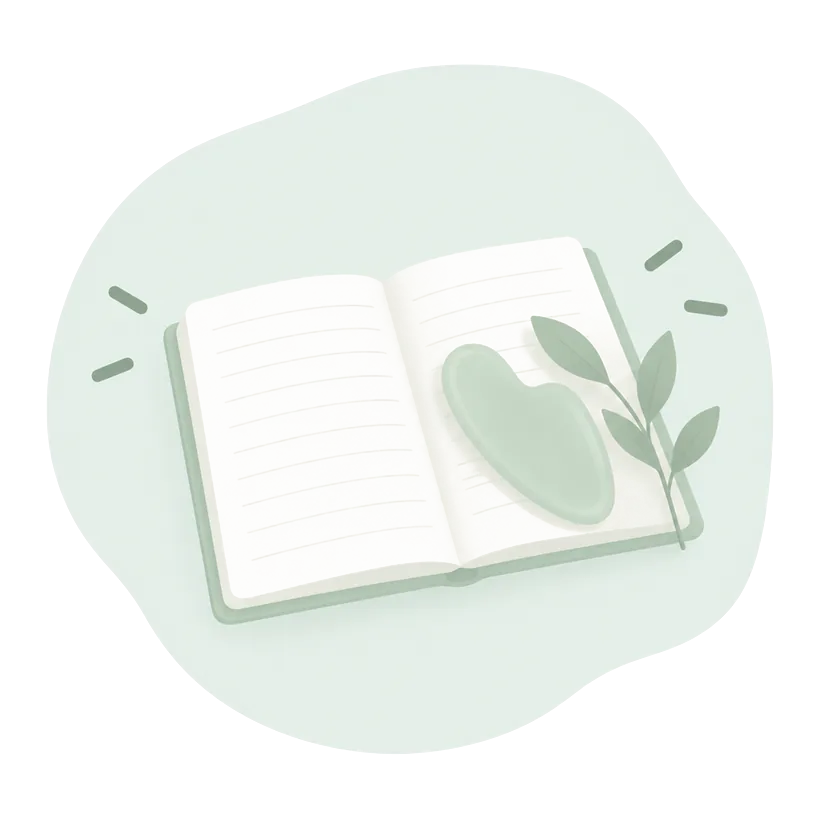
Gua sha comes from a traditional Chinese practice of scraping the body. The facial version, much gentler, uses a flat, smooth stone that you glide over oiled skin. It’s used to massage, to relax and to support circulation, with very light movements.
Choosing your tool
- A stone that is smooth, with no cracks or chips, and rounded edges.
- A notch to follow the jawbone, a long edge for the cheeks and neck, a curve for the eye area.
- The material (rose quartz, jade, stainless steel) matters less than the finish. Steel is easy to clean and stays cool.
The right technique
- Clean, oiled skin. Without glide, the stone drags on the skin. A few drops of oil or a rich serum are enough.
- Stone almost flat. Tilt it at about fifteen degrees to the skin: the flatter it lies, the gentler the stroke.
- Light pressure. On the face, you just skim the surface. The neck can take a little more pressure, but never on the front of the throat.
- Always in the same direction. From the center outward and from bottom to top on the face, toward the collarbones on the neck.
- Three to five strokes per area, then move on to the next area.
- Start and finish with the neck, to support drainage.
What’s normal, and what isn’t
Slight redness that fades within a few minutes is common. Marks, tiny red dots or pain mean the pressure is too strong: lighten your touch. On the face, gua sha should stay comfortable from start to finish.
When to skip it
- On irritated, damaged or sunburned skin, or during an inflammatory acne flare-up.
- Over a pimple, a lesion or a raised mole.
- After a cosmetic procedure, until your practitioner has given the go-ahead.
- If you take anticoagulant medication or you bruise easily: ask your doctor’s advice first.
Hygiene
- Wash your stone after every use with lukewarm water and mild soap, then dry it.
- Store it away from dust, in a clean pouch.
- Don’t share it.
- A cracked or chipped stone needs replacing: a damaged edge can hurt your skin.